Rithum launches Rithum Home app for iOS and Android
OpenAudio Brings Deeper KNX Integration to HOLO-WHAS Multi-Zone Audio with Real-Time Media Metadata
OpenAudio Brings Deeper KNX Integration to HOLO-WHAS Multi-Zone Audio with Real-Time Media Metadata
16-channel, 8-zone, 8-stream architecture now delivers meaningful music information directly into KNX visualisation and control environments
OpenAudio has significantly expanded the integration capabilities of its HOLO-WHAS range of multi-room streaming amplifiers, introducing enhanced KNX integration with real-time media metadata.
Available in Australia and New Zealand through AVOZ, the OpenAudio HOLO-WHAS platform combines multi-room streaming, amplification, matrix routing, DSP processing and automation integration within a single hardware platform. The latest KNX functionality takes that integration considerably further, allowing compatible KNX control systems to display not only audio controls, but also information about the content currently being played.
At the heart of the HOLO-WHAS concept is a powerful 16-channel architecture providing eight independent audio zones and eight streaming sources. Depending on the model, the platform provides up to 100W or 200W per channel, while allowing multiple sources to be routed independently to different areas of a home or building. The HOLO-WHAS Plus, for example, provides 16 x 100W of amplification, delivering 1,600W of total output.
What makes the latest development particularly significant for KNX integrators is the move from simple command-and-control functionality towards two-way, information-rich audio integration.
From Audio Control to Complete Audio Visibility
KNX has long provided a powerful foundation for controlling lighting, HVAC, shading, security and other building systems. Audio, however, has traditionally been more difficult to integrate at the same level of sophistication.
The original OpenAudio KNX implementation already provided four fundamental functions:
Mute control
Volume control
Source selection
Audio routing
The latest development adds a further layer of information to the KNX environment, providing access to:
Track title
Artist name
Album information
Playback status
Playback progress
This means that a KNX touch panel or visualisation interface can now become a genuine audio interface rather than simply a collection of volume and source-control buttons.
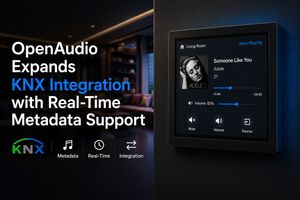
For the homeowner, the difference is immediately apparent. Rather than seeing simply "Music" or "Audio On", a KNX interface can display what is actually playing, together with artist, album and playback information. The supplied KNX visualisation example demonstrates the progression clearly: the basic Mute, Volume and Source controls remain, while the enhanced interface adds album artwork, title, artist, album, playback status and a progress bar.
Designed for the Modern Smart Home
The HOLO-WHAS architecture is particularly well suited to sophisticated residential automation because the audio system does not need to be built around a collection of separate components.
Instead, OpenAudio combines streaming, amplification, source management, matrix routing, DSP and automation integration into one platform. This can substantially simplify the architecture of a multi-zone audio installation while giving the integrator greater control over how audio behaves throughout the property.
The HOLO-WHAS Plus, for example, supports eight streaming sources and eight zones, with the ability to route any combination of sources to any combination of zones. Its streaming options include Qobuz Connect, AirPlay 2, Spotify Connect, DLNA and Bluetooth, while physical inputs include RCA, SPDIF, USB and HDMI ARC.
OpenAudio's architecture also supports sophisticated routing scenarios. The company's platform describes 1-to-N, M-to-1 and M-to-N routing, meaning that audio can be distributed to multiple zones, multiple sources can be directed towards different zones, or groups of zones can be configured according to the requirements of the installation.
For larger projects, multiple OpenAudio devices can also be deployed as part of a broader centralised multi-room system. OpenAudio states that its architecture provides eight zones per device and can be cascaded to support larger installations.
A More Intelligent KNX Audio Experience
The significance of real-time metadata goes beyond simply making an interface look better.
For integrators, metadata opens the door to more meaningful visualisation and automation experiences. A KNX touch panel located in a kitchen, living room, bedroom or entertainment area can provide users with contextual information about their music without requiring a separate audio control application.
The supplied OpenAudio demonstration illustrates this approach, showing a KNX interface presenting the currently playing track alongside album artwork, artist and album information, playback status and progress, while retaining conventional volume, mute and source controls.
According to Darren Ma, Ph.D., Business Development Director at OpenAudio: "Audio has traditionally been one of the least integrated subsystems within many building automation projects. While users could control volume and source selection, they often lacked visibility into what content was actually being played. By bringing metadata directly into the KNX ecosystem, we are helping create a more seamless and informative user experience."
One Platform. Eight Zones. Eight Streams. 16 Channels.
For professional integrators, the HOLO-WHAS range provides a compelling proposition: a high-capacity multi-zone audio platform that can sit at the centre of a KNX-controlled property without requiring separate streamers, matrix processors and multi-channel amplifiers for each part of the system.
The result is a cleaner system architecture, fewer individual components and a unified approach to audio distribution.
The platform is equally relevant beyond luxury residential projects. OpenAudio identifies smart home, hospitalit